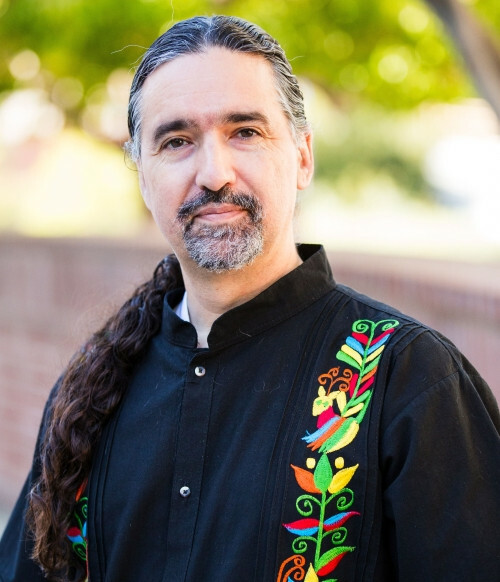
I'm Dr. Luis Morales Knight. I'm a licensed psychologist who's taken a fairly unconventional career path. I started out as a linguistics major at UCSB, which gave me a strong practical grounding in how to talk to people across cultural lines—on top of already growing up bilingual and bicultural, mind, which is all about learning to see the world through a variety of eyes! Becoming multilingual just helped me see things in a more multicultural way. After graduating, I respecialized in psychology via a Master's degree at Pepperdine University, which I completed while also working full-time. The experience of being a nontraditional working student left indelible marks on how I think about work, learning, and adulthood.
I completed my doctoral degree at the University of Nebraska—Lincoln, and stayed in Nebraska to complete my internship (at the University of Nebraska Medical Center) and postdoc (at Boys Town). Life in Nebraska showed me a different kind of American life than I'd known so far, though one that also rhymed in interesting ways with the semi-rural setting I'd grown up in on the Central Coast. My study and training shaped me up to be a clinician working with adults, children, parents, and families, gave me a couple of specialty areas—anxiety and parenting, primarily—and gave me an overall identity as a behaviorist, which I'll talk about on the "About us" page.
After postdoc, I was tapped to open and run a nonprofit psychology clinic for Boys Town California, in Orange County, which I did for several years, as their Director of Behavioral Health. Then I co-founded a private practice, Child and Adolescent Behavioral Health Center, which is still running strong. Currently, I'm a professor in California Lutheran University's doctoral program in clinical psychology. That's been my favorite gig so far, but we'll see what I decide to do when I grow up.
I'm also a husband (twenty years and counting) and a father to two teen kids. Navigating the hard work of building a strong marriage, and the harder work of raising children, has also very much marked how I approach my profession. There aren't any easy answers—only our answers, and how we stay in dialogue with the world's questions.